directions definition of chashama homebase
programs about everything that ever happened get involved support chashama
. . .
. PRESS

On Edge
by C. Carr
Avant Midtown
Chashama Uplifts the New Times Square
May 8 - 14, 2002


Four storefronts on West 42nd Street have become unique arts sites.
(photo: Cary Conover)


That old boho energy now quivers unexpectedly along 42nd Street, between Sixth and Seventh avenues, just a swift kick away from Disney and the other neon nabobs. The location of this art effusion is one of post-gentrification's little ironies. Forget the cheap neighborhoods; there aren't any left. (Not Williamsburg, not DUMBO, etc.) So set the controls for the heart of the beast. Downtown just found a midtown sublet.

Four storefronts on the block between Sixth and Seventh have become unique theaters under the auspices of Chashama, an organization founded in 1995 by principal players in Reza Abdoh's experimental theater company, Dar a Luz. Chashama's declared intention is to bring experimental art to commercial areas and unsuspecting audiences. That it's done. But perhaps the most invaluable gift Chashama has to offer in an age without wiggle room is space. In addition to the four theaters on 42nd Street, Chashama has parceled out studios for artists in a 57th Street building—40,000 square feet, and it's all free.
This month Chashama moves to an unprecedented level of activity with their Oasis Festival, offering free film, dance, and theater events every day through the beginning of June. They'd planned it as a kind of swan song to 42nd Street, thinking they had to move out in June. Now construction on the new office building has been delayed, and they have till the end of the year.
So the scene is temporary—but then, from Montmartre to the East Village, weren't they all? The property belongs to the Durst Organization, the developers who erected the Condé Nast building and own other chunks of midtown, and they have big plans for the space. But for now they've turned it over to Anita Durst, a founding member of Dar a Luz and Chashama's artistic director.
Durst says Chashama began out of a feeling that Dar a Luz had to somehow keep Abdoh's energy going after he died of AIDS in 1995. "That's what it's about for me," she says. "Creating the kind of energy that Reza gave me. Because he took me out of a box. He opened me up to things I never would have imagined. So that's what I'm trying to do with Chashama. Give that healing, that creativity, that space." Chashama means "spring outlet" or "of my eye" (depending on pronunciation) in Farsi, Abdoh's native language.
Indeed, Chashama offers a playful do-anything ambience long missing Downtown. The storefront housing the Oasis Festival is the only one with a regular proscenium stage. The other three have interiors designed by the people performing in them, right down to one fur-lined bathroom.
In a former haberdashery slightly wider (perhaps) than a jumbo jet, the National Theater of the United States of America built itself a long skinny stage to accommodate its current madcap effort, Placebo Sunrise, set in the corridor of a surreal cruise ship. NTUSA's antic sensibility extends to the little bandbox built for spectators. From the "Imperial Box" ($25) to the "Makeout Balcony" ($7), 40 people pack the house.
The Thing opened last week a couple of doors west. Performance artist Julie Atlas Muz installed a six-inch pond as her stage, lugged in 34 tree stumps for the audience to sit on, and carpeted this little forest glade with $600 worth of pennies. Spectators sit mere inches from the water, wearing ponchos.
Meanwhile, Durst is directing The World of the P Cult, with a cast drawn from nightclubs (go-go dancers) and the Living Theater. Durst asked metalsmith Veronica Evanega to design the set—and to make whatever she wanted. The result is a metal catwalk about seven feet high hugging the walls of a former deli, with a small Plexiglas stage and what appears to be a slice of roller-coaster track. Spectators will stand.
Durst had an unconven-tional introduction to the arts. Dropping out of school in the 10th grade, severely dyslexic, she was enrolled in a program she describes as "10-minute classes, not very educational. Then you worked the rest of the day." But when someone came in to do theater with them, she was hooked. She moved from Westchester into Manhattan to study acting and lived with her grandfather, the realtor Seymour Durst, in the middle of his amazing Old York Library collection of 13,000 books, 20,000 postcards, and piles of ephemera related to New York City history. He even had books in the refrigerator.
"Along with the food?"
"Instead of the food."
(Seymour Durst also put up the National Debt Clock on Sixth Avenue, blinking its horrible numbers for years, bumming everyone out. An art project, really.)
Anita Durst became an assistant to Annie Hamburger of En Garde Arts, which put theater productions into nontraditional settings during the '90s. A pier. A warehouse. Even once—for Mac Wellman's Crowbar—in an actual 42nd Street theater, though the audience sat on the stage. That was in 1990, when Douglas Durst, Anita's father, owned the theater.
"Then I met Reza," says Anita. "I got him all the spaces he had in New York. Even when they weren't from my family. I had, you know, the connections." Indeed, Douglas Durst, who sits on the board of a couple Off-Broadway theater companies, was not hard to persuade. "He gave me 57th Street," says Anita. "I didn't ask him."
Up at the 57th Street site, Durst shows me through a couple of cavernous floors that used to house Artkraft Straus, a company that made signs for Broadway shows. Much of the space is open, and artists have marked off their turf with plastic, dropcloths, and curtains. A few even built walls with locking doors. Durst can't remember the exact number now using the space, probably 50 or 60. That doesn't include the occasional desperate dancer who comes to rehearse despite the bad floors.
Durst has a dream of turning Chashama into a kind of Real Estate for the Arts program modeled on Materials for the Arts and Lawyers for the Arts. The idea is that developers would donate temporarily empty space, maybe in exchange for a tax deduction, and Chashama would turn it over to artists. "I'm going to try to do it without my family's assistance," says Durst, who's been supporting Chashama in part with family money. "If this is going to happen, I want it to happen on its own. Or with other people's support."
"Like 1 Times Square," she says, as we get out of a cab across the street from it, center of the universe when the New Year's Eve ball drops, currently empty and forlorn. "That's such a vital spot for New York. Even if we just put some window performances in there . . . "
I haven't even touched on the window installations or the outreach program for youth at risk. Chashama has to be the most ambitious new arts group to come along in a decade, a blast of fresh air against the fetid '90s. But last week, a piece of the roof collapsed at the 57th Street site, and Anita Durst was hoping to bunk the second-floor artists in with the first floor. It's a precarious business. I mean art, not real estate.
For information, visit www.chashama.org.

TOP>>>

HOME>>>


Timeout
Issue 340: April 4–11, 2002
CHASHAMA:THE NEW ARTS AT ST. ANN'S

Photographs by Shaniqwa Jarvis (bottom) and Paula Court


When Arts at St. Ann's moved from St. Ann's Church in Brooklyn Heights to its huge, new, stylish digs in Dumbo in October, the wide-ranging arts organization finally had a home to call its own. Its scheduling policy, however, remains enticingly eclectic: February saw the opening of Wooster Group's To You, the Birdie! (Phèdre) (above right); this week, former Clashman Joe Strummer brings his new band to the warehouse space, and later this month, the Builders Association will present Xtravaganza, a multimedia retrospective on the history of entertainment. Now, a collective known as Chashama (above left) has opened four down 'n' dirty spaces in Times Square, where cutting-edge plays and installation–performance-art productions come to life. How'd they score such prime property? Chalk it up to a serendipitous combination of real-estate availability and connections (artistic director Anita Durst's father owns the buildings). It won't be there forever, though. By as early as September, the spaces may be sold to more profitable tenants. So get there while you can.—David Cote
•St. Ann's Warehouse, 38 Water St between Dock and Main Sts, Dumbo, Brooklyn (718-858-2424). Subway: A, C to High St; F to York St; 1, 2 to Clark St.
•Chashama, 135 W 42nd St between Sixth Ave and Broadway (212-391-8151; www.chashama.org ). Subway: B, D, F, V to 42nd St; N, Q, R, W, 42nd St S, 1, 2, 3, 7 to 42nd St–Times Sq.

TOP>>>

HOME>>>


Best Low-Rent Theatrical Multiplex- CHASHAMA
Amid the crush and hustle of midtown, who knew a sprawl was possible, but the CHASHAMA complex of theaters somehow manages to loll luxuriously over four converted storefronts on 42nd Street. Founded in 1995 by members of Reza Abdoh's legendary Dar A Luz company, and maintained by a breathtaking amount of grants, Chashama plays host to a dizzying schedule of low-cost (or free) theater, dance, comedy, and performance art, and curates a series of window installations. And how many in midtown can boast a fur-lined bathroom? These spaces are only temporary—construction of an office building is planned—but isn't theater supposed to be ephemeral anyway? -Alexis Soloski

TOP>>>

HOME>>>


THE NEW YORK TIMES
August 21, 2000, Monday

THE ARTS/CULTURAL DESK DANCE REVIEW
Store Window Duets to Delight the Jaded
By JENNIFER DUNNING

Anita Durst and Despina Stamos are onto something with Deli Dances in Times Square. The free series provides the ultimate in New York serendipity to passers-by in the area. On Friday at lunchtime, camera-toting tourists, shoppers and office workers joined dance fans on comfortable banquettes to watch shrewdly chosen modern-dance pieces in a simple black-box theater in an empty store on 42nd Street near Broadway. Outside, dancers performed in the store's display window, attracting quite a crowd.
Miguel Gutierrez and Erin Cornell opened the first hour of the all-day marathon that closed the series. Their untitled duet had the two, dressed in tennis skirts and tops, moving with enjoyably astringent energy to Latin music. Then came Bianca Falco and Elise Knudson in ''Interlude,'' an imaginative duet for two bodies joined at the hands.
The shapes Ms. Falco and Ms. Knudson made and the ways they clung to each other, pulled away and rebounded made for witty physical comedy with surprising emotional nuances. The ending, in which the two shared tea from a pot on a tiny table at the back, was a charming surprise and a perfect close to the piece.
The dancers in Le Minh Tam's untitled group piece also made intriguing shapes, this time with a length of white fabric that served as a river, the boundaries of a stage within the stage and a screen. The large cast was divided into a group of bouncing, wheeling women in white dresses and four dancers in red and black who moved in a mix of the martial arts and contact improvisation genres. A shorter version of the work would have been much more effective, however, particularly in this setting.
The improvisational duet by Andrew Suseno and Stacey Royce should have been dreadful but was inspired. Mr. Suseno and Ms. Royce are well matched and comfortable with each other as improvisation partners. But they also had a nicely relaxed way with the audience, soon having people call out ''stop'' and ''start'' to one or both of the performers. Some of the freezes were hilarious.
Audiences came and went all the while, handed on through the dark theater by Julie Atlas Muz, the Bemused Blonde of downtown performance art and the afternoon's host. The audience comments were perceptive, enjoyably freewheeling and often fascinating, particularly given the blessed absence of the kind of discussions that are now de rigueur before and after dance performances. What about making Deli Dances a year-round event?

TOP>>>

HOME>>>


chashama Brings Cutting-Edge Performance to Times Square
by Laura Muehlburg
Please remove your shoes and socks before entering the theater. Put on the plastic poncho, which you’ll find on your tree stump, because you might get wet when the dancers splash. Use the bathroom next door before the show stats because there isn’t one here. The performance is called The Thing. It’s an hour long and is about what happens when people throw coins into fountains and make wishes. Enjoy it and stay dry.
Welcome to Chashama-land, one of the last scruffy pieces in Times Square. It’s a crazy quilt of electronics stores, a Tad’s Steakhouse and four storefronts – 111, 125, 129 and 135 – dedicated to experimental art. Chashama’s artistic director is Anita Durst, daughter of Douglas Durst, a third-generation New York real estate developer. The Durst organization owns most of the block and has allowed Anita to use space there since 1997, when her father built Four Times Square next door. Anita Durst manages the storefront spaces and lets artists use the theaters and windows free of charge. Many of them have studios tucked away inside the buildings. It’s an extraordinary arrangement, which is scheduled to continue until December, when the storefronts will be demolished for her family’s next building, an office tower called One Bryant Park. Although Durst doesn’t know where Chashama will be after that, she has a plan for continuing her arts patronage.
Durst started asking for space for theatrical productions in the early 1990s when she performed with the experimental company Dar A Luz, formed by the Persian director Reza Abdoh, who suggested the idea. The first space her father arranged for them to use was the Diplomat Hotel on 43rd Street, since demolished, where they performed a play about Jeffrey Dahmer and Andy Warhol called The Law of Remains. After Abdoh’s death in 1995, several of his company members formed Chashama. They chose the word, which means “shame” in Arabic and “source” in Persian, to represent two ideas: the shame of baring one’s soul before an audience and the source of creativity. Their first piece, Jr. Black’s Office, was set on the second floor of a vacant office building downtown at 40 Worth Street. Each performance lasted about two hours and was broadcast over a pirated FM radio station so that people on the street below could listen to it in their cars or on their headsets. A cast of 25 actors performed scenes in the windows loosely based on the idea of incarceration.


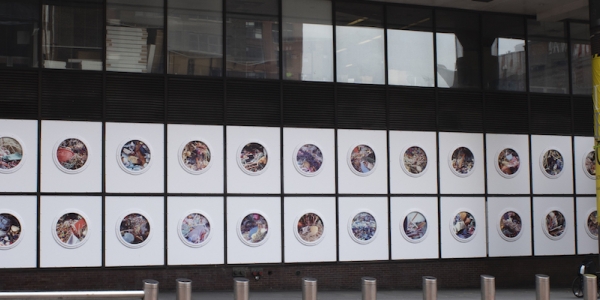
In 1997, Chashama moved to 135 West 42nd Street into a former Herman’s Sporting Goods store. Although the space was meant for retail, not theater, what better place could there be to stage performances and art than in huge windows on one of the busiest streets in Manhattan?
And she knows the space’s worth. Her family owns 10 office buildings and several million square feet of space, primarily on Third and Sixth Avenues in Manhattan. Their wealth is estimated to be hundreds of millions of dollars. “I live a fairy tale life….I can give so, so, so much,” she said. She produces many performances at Chashama and is especially generous to the artists-in-residence who work for the organization without earning much money. Durst lets them experiment and find their voices without interfering in their work. She says that seeing them grow – artistically and commercially – is her reward.
For artists without a home or money, presenting work at Chashama can be alluring. Mark Greenfield and his Faux-Real Theater Company spent three months there in 2001 performing an interactive piece called Fun Box Times Square. Greenfield, who met Durst several years earlier, was delighted with the space and estimates that Durst gave him $30,000 worth of in-kind contributions. He regretted having to leave Chashama at the end of the three months, but respected Durst for keeping her promise to the next performer. Greenfield says that her generosity and commitment to experimental art is serious, “She has been a patron of the arts in the truest sense in a city where the climate is contrary to that, ” he says. This October, the Faux-Real Theater will return to Chashama to present Haunted House, a show composed of Shakespeare’s words set in today’s Manhattan.
Along with funding, space is a theater company’s most serious concern. Even though Chashama’s resources are greater than those of most young theater companies, the length of its stay at 135 West 42nd Street has always been uncertain. As a result, its members planned performances that could be set up and dismantled quickly. Later, Chashama moved into 111 West 42nd Street as well as the storefronts at 125 and 129 West 42nd. In these spaces, Durst and her colleagues created a 100-seat black box theater, a 40-seat theater, a 12-seat theater and a couple of flexible spaces that can be reconfigured as needed. Nine visual artists and a theater company carved out studios in the warren of awkward spaces that couldn’t be used for performances or displays.
Chashama’s mission changed as it expanded. Says Durst, “It started out we were going make our own performances. We have changed to a presenting company.” She gives artists space on a first-come, first-served basis regardless of whether or not she likes their work. The hardest part of being in her position, she says, is turning people away when space isn’t available.
One of the lucky ones is Yehuda Duenyas, an artist- in-residence at Chashama since 1997. He works as its technical director, building sets, lighting plays and doing whatever else needs to be done. “It’s a little nebulous,” he said, “We all do everything.” Duenyas created 10 performances for Chashama’s windows and theaters during his tenure. He formed a theater company called The National Theater of the United States of America with a few other actors. Their recent play, Placebo Sunrise-- an existential farce about two men who are abducted by sinister deckhands and forced aboard a deranged cruise ship-- was so popular that its run was extended from spring into summer. The company members mounted the energetic, professional production for less than $20,000. If they had created it anywhere else, Duenyas estimates they might have spent more than $300,000 on rent and materials.
The show was part of Chashamafest, a celebration of theater, dance, film and visual art that ran from May through June, Chashama’s tentative departure date. After scheduling the events and coordinating the artists, its members learned that they could stay on the block until December. Durst and her colleagues have just about finished planning the fall season – which includes a circus, happy hour shows, a 24-hour Hamlet marathon, an invitational theater festival sponsored by New York Post critic Chip Deffa and more theater, dance and window performances. On November 1, Chashama will begin accepting proposals from artists for the winter season.
Whatever they choose to feature, it will be both experimental and accessible. Laura Barnett, a performer and curator, describes the art at Chashama as being at “heart and eye level, not billboard level.” Last year, Barnett organized performances and visual art for Chashama’s windows. This year, Barnett and co-curator Caterina Bartha assembled “Windows on 42nd Street,” a more ambitious version of last year’s project. From March through June, the curators scheduled 200 artists representing 40 companies to appear in the windows. In order to be selected for the series, artists had to consider the context of their performance – a Times Square window – and propose an idea appropriate for the space. Other than that, and Durst’s ban on fire and nudity, there were few guidelines.
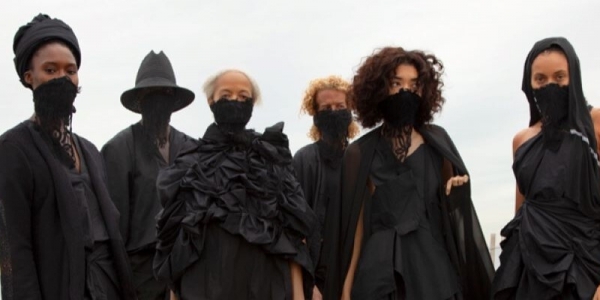
Many of the window performances surprised passersbys. “I’ve had comments like, ‘What are you trying to sell?’” Bartha said. Usually, audiences are delighted to learn that it’s free art created to entertain them, she said, but not everybody understands it. At a performance called “The Mummy Project,” actors in elaborate costumes whose faces were wrapped in cloth perplexed a young woman. “What are they doing? How can they breathe?” she asked her friend. Another woman called the performance “weird” and walked away.
Chashama brings a tremendous – practically overwhelming – amount of experimental art to a neighborhood that is more accustomed to polished Broadway productions and big Hollywood movies. Experienced and emerging artists alike are invited to present their work at Chashama, where people are constantly mingling and bustling around. “It’s a very present-tense place,” said Barnett. “There’s a certain kind of freshness and energy that comes with that.”
When Durst, who is an artist and performer, isn’t thinking about her own projects and the day-to-day activities of Chashama, she’s considering its future. After December, when it’s scheduled to be torn down to make way for the new, 50-story office tower, Chashama will still exist – she just doesn’t know where. Durst doesn’t sound bitter about the buildings’ demise; she’s pleased that she’s been able to use them for so long. Her latest idea is to become a space broker, a person who places artists in buildings that are temporarily vacant. She’s working with attorneys to see if landlords can get tax breaks when they give artists space on a short-term basis.
“There are so many artists here with no place to work,” said Durst, who has begun hunting for more space. She’s inquired about using the windows at One Times Square for performances and her father has contacted the owners of that building with her request. Adding art to a bustling commercial center humanizes and invigorates it. Durst wants to do with other neighborhoods what Chashama has done for its small stretch of 42nd Street: “We’re here to create a community with an energy that is very unafraid to experiment.”

TOP>>>

HOME>>>


'2 FOR 1' IS
TWICE THE FUN
By CHIP DEFFAA


January 31, 2002 -- KUDOS to Mark Gindick, Matthew Morgan and Ambrose Martos - three irrepressible, post-modern circus clowns billed, collectively, as Happy Hour.
And kudos to Chashama Theater Artistic Director Anita Durst, who's brought this irresistible, high-energy, family-oriented entertainment to Times Square and is keeping ticket prices ridiculously low - $12 and sometimes even less, thanks to 2-for-1 ticketing and other deals.
What you get is a fast-paced performance, suitable for all ages, in which the classic elements of clowning - slapstick, mime, pratfalls, whoopee cushions and acrobatics - are set to contemporary musical rhythms with a nicely ironic, self-deprecating tone.
At one point, the endearing, impish Gindick even dares to "risk his life" by eating Pop Rocks candy and drinking a Coke. (Anyone of a certain age may recall the urban legend that swept the country, circa 1975, that combining Pop Rocks and cola was lethal.)
There's also a mock striptease, fun with a mini-trampoline and birthday cake (if you're lucky, you'll end up with a piece).
Granted, the music was louder than ideal, and Martin let one bit - in which he vainly tried to get an audience member to help him up after a split - go on way too long. If the audience doesn't cooperate the way a performer wants, the performer has got to move on; if a battle of wills develops between a performer and the audience, it's uncomfortable.
That said, there is much to enjoy here. These clowns are adding welcome new life to 42nd Street.
2 FOR 1
Chashama Theater, 111 W. 42nd St., between Broadway and Sixth Avenue, (212) 631-5819. Thursdays-Saturdays at 8 p.m., Sundays at 3 p.m. Through Feb. 9.
Article 7
Stage Left
November 28 - December 4, 2001

Strangers in a Strange Land
Richard Foreman’s 'Now That Communism Is Dead, My Life Feels Empty'

Chashama, like so many worthwhile and wonderful things, has a sword of Damocles hanging over it. The Off-Off-Broadway theater complex, which consists of four storefronts and adjacent office space, enjoys a prime location for such a rough-and-tumble venue—it's on 42nd Street, half a block from Times Square. Company member Anita Durst is a member of the Durst family, who owns the site. The catch is that the moment the Durst Organization gets a proper, rent-paying tenant, the gang in black turtlenecks has to vamoose.

In the meantime, the theater geeks are making the most of it. Chashama's latest innovation is a series of workshops for serious Off-Off professionals, organized by company member Tony Torn. A downtown actor and director of some repute (as well as the son of actor Rip Torn), he brings a wild and eclectic curriculum vitae to this endeavor, which he calls Zero One (it was called Ground Zero until September 11). Zero One functions as a kind of oasis in this Midtown neighborhood, surrounded as it is by scores of dubious "acting schools" poised to fleece wide-eyed hopefuls the instant they disembark at Port Authority. "Pay what you can" is the heretical password at Zero One, at least for the first six weeks, after which they switch to a sliding scale. Participants get voice training taught by Linklater devotee Tom Pearl, improv by Mike McCartney, scene work with Torn, and movement by Durst and Julie Atlas Muz. Rather than the typical "guru" model of theater training, the format is open. The teachers are there to learn as much as the students. At a recent class, a student's description of a performance technique he'd studied in England elicited a request from Torn to come teach it at a future session.
If some of the exercises sound familiar, their content is decidedly not. While Torn stresses that Zero One is not an experimental workshop per se, he does have a fondness for nonsensical text that would certainly blow the mind of an actor looking for his next soap opera audition. For example, Torn loves to force actors to cope with a strange parody he pulled off the Internet—it consists of a "Cosmo Quiz" in conversation with the "Spirit of Scientology." For the most part, Zero One's clientele matches the forum. In the improv section, a student assigned to tell a simple, real-life anecdote related a tale about an acid-fueled junket to a UFO convention in Roswell, New Mexico. Zero One received a few unidentified visitors of their own during a recent Monday class, when three street people burst in. "I'm here about the job," said one. "There's no job here, man," the teacher replied, inadvertently revealing another important truth about the theater. —Trav S.D.

TOP>>>

HOME>>>

.
. . .